
Council Housing and Dwelling Assumptions
Within Place Forecast, we project dwellings. You, dear client, can influence how we project dwellings via dwelling assumptions.
Dwelling assumptions are an input to your forecast in the form of a client dataset. This dataset contains changes to the dwelling projections based on local council data, such as additional dwellings in the future or reductions to existing dwelling stock.
This document describes the data structure of the dwelling assumptions dataset and its effect on dwelling projections.
A small area can also borrow the demographic rates of another area that suits it better. That’s a donor assumption, and it sits in the same sheet as your dwelling assumptions.
Some Considerations for Dwelling Assumptions
- Assumptions are applied to small area forecasts.
- Dwelling assumptions lead to dwelling assumption adjustments of dwelling projections. Housing assumptions lead to housing assumption adjustments of average household size and population in dwellings.
- Assumptions can only affect projected data, never estimated data.
- Assumptions can be expressed in any one of these categories:
- Addition relative to the current amount of projected dwellings,
- Reduction relative to the current amount of projected dwellings or
- Override to a target number of projected dwellings.
- Applying a ceiling to constrain projected dwellings to a maximum.
- Donor, using the demographic rates of another area (the donor) in place of the small area’s own.
- These categories will be applied in the following order:
- Additions
- Reductions
- Overrides
- Ceilings
- Donor assumptions sit outside this order, because they change rates rather than dwellings. A small area can carry dwelling assumptions and a donor assumption together.
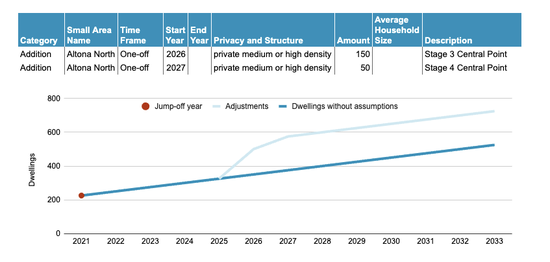
Example: Adding Dwellings Once I
Example: Adding Dwellings Once I
In the small area of Altona North, a building project named Central Point finishes its 3rd stage in the year 2026 with 150 extra dwellings on top of the current projections and its 4th stage in the year 2027 with 50 extra dwellings on top of the current projections. All these dwellings are private and medium or high density.
Approach: Add 150 private medium or high density dwellings as a one-off in 2026 to the dwelling projections for the small area of Altona North, and then 50 more as a one-off in 2027.
Example: Adding Dwellings Repeatedly
In the small area of Altona North, a building project named Central Point finishes its stages 5 to 9 in the years 2027 to 2031. In each of these years, 200 extra dwellings are going to be completed on top of the current dwelling projections. All these dwellings are private and medium or high density.
Approach: Add 200 private medium or high density dwellings every year in the time span starting in 2027 and ending in 2031 to the dwelling projections for the small area of Altona North.
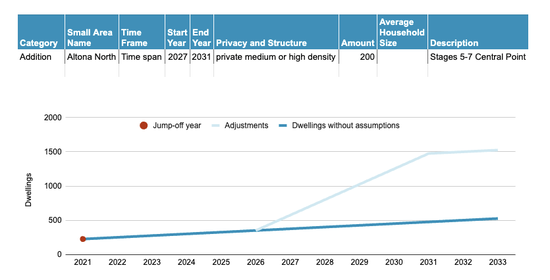
Example: Adding Dwellings Repeatedly
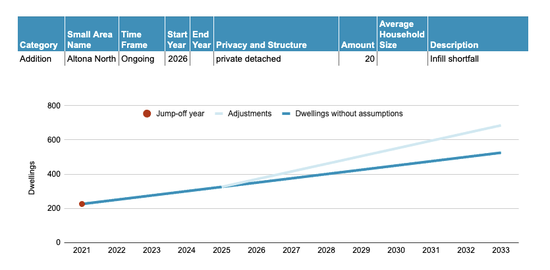
Example: Adding Dwellings Ongoing
Example: Adding Dwellings Ongoing
The small area of Altona North expects to experience an infill increase from a zoning change. From 2026 onwards, 20 private detached dwellings will be added on top of the current dwelling projections for each year.
Approach: Add 20 private detached dwellings from 2026 on an ongoing basis each year to the dwelling projections for the small area of Altona North.
Example: Reducing Dwellings Ongoing
In the small area of Altona North, to compensate for a capacity constraint, from 2030 onwards, for each year, the current dwelling projections are reduced by 20 private detached dwellings.
Approach: Reduce the dwelling projections by 20 detached dwellings from 2030 on an ongoing basis each year for the small area of Altona North.
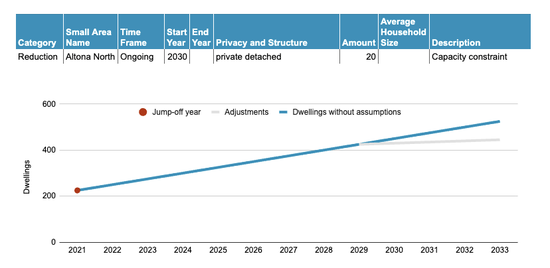
Example: Reducing Dwellings Ongoing
Example: Reducing Dwellings Once II
Example: Reducing Dwellings Once II
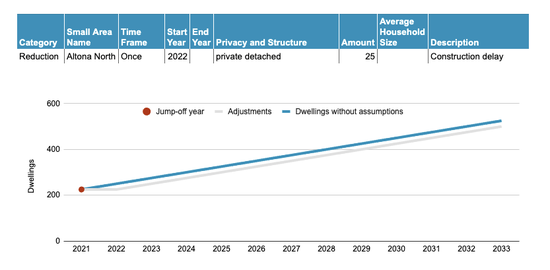
The small area of Altona North experienced a construction delay that has not been reflected between the building approvals and completions yet. As a result, the currently projected dwellings need to be reduced by 25 dwellings once as an offset.
Approach: Reduce the dwelling projections by 25 detached dwellings for 2022 for the small area of Altona North.
Example: Adding Non-private Dwellings
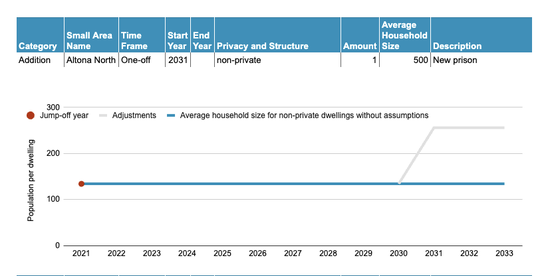
In the small area of Altona North, a new prison will become active in 2031. It has a capacity of 500 people. This area already has two non-private dwellings with an average household size of 134 people per dwelling.
Approach: Add one single non-private dwelling as a one-off in 2031 to the dwelling projections for the small area of Altona North, with an average household size for this building of 500 people per dwelling. This approach changes the average household size for non-private dwellings to 256 people per dwelling.
Example: Adding Non-private Dwellings
Example: Reducing Non-private Dwellings
Example: Reducing Non-private Dwellings
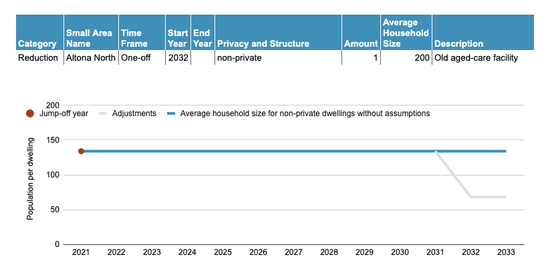
In the small area of Altona North, an old aged-care facility will be retired in 2032. It has a capacity of 200 people. This area already has two non-private dwellings with an average household size of 134 people per dwelling.
Approach: Reduce the current dwellings by one single non-private dwelling as a one-off in 2032 to the dwelling projections for the small area of Altona North, with an average household size for this building of 200 people per dwelling. This approach changes the average household size for non-private dwellings to 68 people per dwelling.
Example: Override Dwellings Ongoing
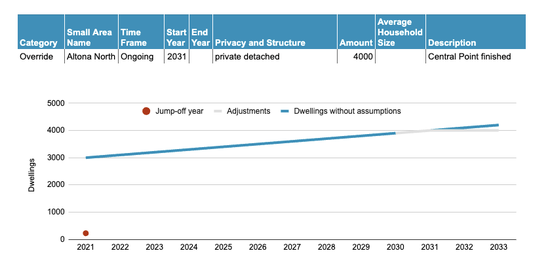
In the small area of Altona North, a building project named Central Point is expected to be finished by 2030. It is the only building project in this small area at this point. From 2031, the overall dwelling capacity of 450 dwellings will be reached.
Approach: Override the current dwelling amount to 450 dwellings from 2031 onwards.
Example: Override Dwellings Ongoing
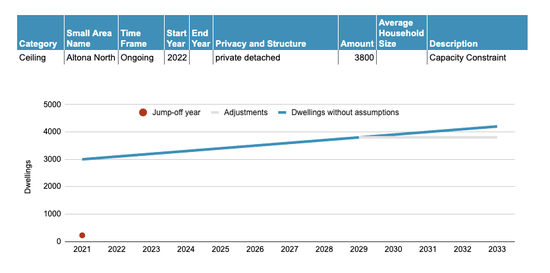
Example: Ongoing Ceiling for Dwellings
Example: Ongoing Ceiling for Dwellings
An analysis of the small area of Altona North has shown that, as of 2022, the overall capacity cannot exceed 3800 private detached dwellings.
Approach: Create a ceiling of 3800 dwellings from 2022 onwards.
Donor Assumptions
In some small areas, the area’s own rates are a poor guide to its future. When an area has few residents, or takes in only parts of the statistical areas it overlaps, its rates are unreliable. In a growth area on farmland today, the rates of today’s residents tell us little about the people expected to move in once it is built.
A donor assumption lets such an area (the recipient) use the demographic rates of another area (the donor) whose rates match what you expect for the recipient. What carries over is rates, never size: the donor’s rates of having children, dying and moving out by age and sex, and the age and sex mix of the people moving in. They are applied to the recipient’s own population, so a donor of 15,000 people suits a recipient of 1,000. The donor’s own forecast is unchanged.
A donation changes who lives in the area, not how many. The total population still follows the dwellings and the household size, so growth comes from the dwellings we project, including your dwelling assumptions. The donated rates take over as the ABS figures for your area run out. Because the ABS publishes births and deaths at different times, the rates of having children and of moving out can start a year before the rates of dying. The age and sex mix of people moving in applies from the year after the latest Census.
A donor assumption can also start later. In a growth area where new housing only begins in, say, 2031, the area keeps its own rates and its own mix of people moving in until 2030, and the donation applies from 2031, when the new residents start to arrive. The year goes in the Start Year field of the Donor row. Choose the first year your dwelling assumptions add dwellings in that area, so the new residents arrive with the donor’s mix.
Tell us which small area you’d like to use a donor, and suggest a donor area if you have one in mind. If the donation should wait for new housing, tell us the year it should start. We prepare the donation and add it to your forecast. You’ll see it as a Donor Assumption dataset on your forecast’s datasets page, and as a Donor row in your assumptions sheet. Each small area can have one donor.
Example: Using a Donor for a Growing Small Area
The place names in this example are fictional.
The small area of Kestrel Rise in the City of Banksia Vale is expected to more than triple in size, from about 1,000 residents today to about 3,600 by 2055, as new housing is built. Rates drawn from today’s small, established population give little basis for who will move in, or for the rates of the growing population. Ironbark Fields in Tallowood Shire is a growth area further along that path, with the rates of having children, dying and moving that Kestrel Rise is expected to have.
Approach: We capture a donation from Ironbark Fields, named Ironbark Fields 2024, and add one Donor row for Kestrel Rise naming that donation. Kestrel Rise’s two planned dwelling projects stay in the sheet as additions over their time spans: the dwellings decide how many people Kestrel Rise can house, and the donation decides the rates of having children, dying and moving out, and the age and sex mix of the people moving in.
Field Reference
This is a description of each column in the table and what it can and cannot do.
Housing and dwelling assumptions are an input to your forecast in the form of a client dataset. Assumptions lead to adjustments of dwelling data based on local council data, such as additional dwellings in the future or reductions to existing dwelling stock. The result of these assumptions are either dwelling assumption adjustments or housing assumption adjustments.
The file needs to include the words housing, dwelling, and assumptions. The file needs to end in .xlsx.
Category
Mandatory. The category of housing and dwelling assumption. Can be
addition(adding to the current dwellings)reduction(reducing the current dwellings)override(overriding the current dwellings)ceiling(constraining to a maximum of the current dwellings)donor(using the demographic rates of the donation named in the fieldDonation)
Small Area Name
Mandatory. The name of the small area to which this assumption will be applied. It needs to be exactly the same name as one of the small areas in your forecast.
Time Frame
Mandatory. The kind of time frame that this dwelling assumption will be applied to. Can be
One-off(this dwelling assumption will be applied to the single year specified in the fieldStart Year)Time span(this dwelling assumption will be applied to the year specified in the fieldStart Year, to the year specified inEnd Year, and to all years between those two years)Ongoing(this dwelling assumption will be applied to the year specified in the fieldStart Yearand to all the subsequent years present in the projection horizon)
Note that the assumption category Ceiling can only use the Ongoing time frame and the category Override can only use the time frames Ongoing and One-off.
Start Year
Mandatory. The year in which the dwelling assumption will first be applied to. Works together with the field Time Frame.
Optional on a Donor row: the year the donation starts. Left blank, the donation starts as the projection takes over (see Donor Assumptions above).
End Year
Mandatory for the time span time frame only. The year in which the dwelling assumptions will be applied to last. Works together with the field Time Frame.
Privacy and Structure
Mandatory. To which kind of dwelling category this dwelling assumption will be applied to. Can be
private detachedprivate medium or high densitynon-privateprivate(automatically splits between detached and medium/high density based on existing proportions in the small area)
Amount
Mandatory. The amount of dwellings that this dwelling assumption represents. Must be a positive integer (1, 2, 3, …, 100, …).
Average Household Size
Mandatory if privacy and structure is non-private. The average household size (average number of people per dwelling) of the dwellings described by this assumption. Must be a positive number and can include decimal places. On an addition or override of a private dwelling type the small area has none of yet, provide it together with an Occupancy Rate, because there is nothing to work it out from. Not used on a reduction of private dwellings, where the people leaving are worked out from the area’s own average household size.
Occupancy Rate
Optional. The share of the new dwellings that will be lived in, between 0 and 1, such as 0.83 for 83 per cent. Needed, together with an Average Household Size, when an addition or override brings in a private dwelling type the small area has none of yet. Not used on a reduction, where reduced dwellings are split by the area’s own occupancy rate.
Donation
Mandatory on a Donor row, and used only there. The name of a donation held against your forecast, spelled exactly as shown on its Donor Assumption dataset.
Description
Mandatory. A description that justifies the existence of this dwelling assumption. Can be any string, but must differ from any other row for the same small area and category.
Donor Rows
A donation is a separate file that we prepare. Its name contains the word donation.
A Donor row uses only the fields in this table. All other fields stay blank.
| Field | Mandatory or optional | What to enter | Example |
|---|---|---|---|
| Category | Mandatory | Donor | Donor |
| Small Area Name | Mandatory | The small area that uses the donation, spelled as in your forecast | Kestrel Rise |
| Start Year | Optional | The year the donation starts: the first year your dwelling assumptions add dwellings in this small area. Leave blank to start as the projection takes over | 2031 |
| Donation | Mandatory | The name of the donation, spelled exactly as shown on its Donor Assumption dataset | Ironbark Fields 2024 |
| Description | Mandatory | Why this small area uses a donor | Growing area; today’s population is too small to project the newcomers from |